CRE
A Simple Cash-on-Cash Framework
By Khai Tran · · 5 min read
Work through cash flow, total cash invested, and downside assumptions in this cash-on-cash example for commercial property conversations.
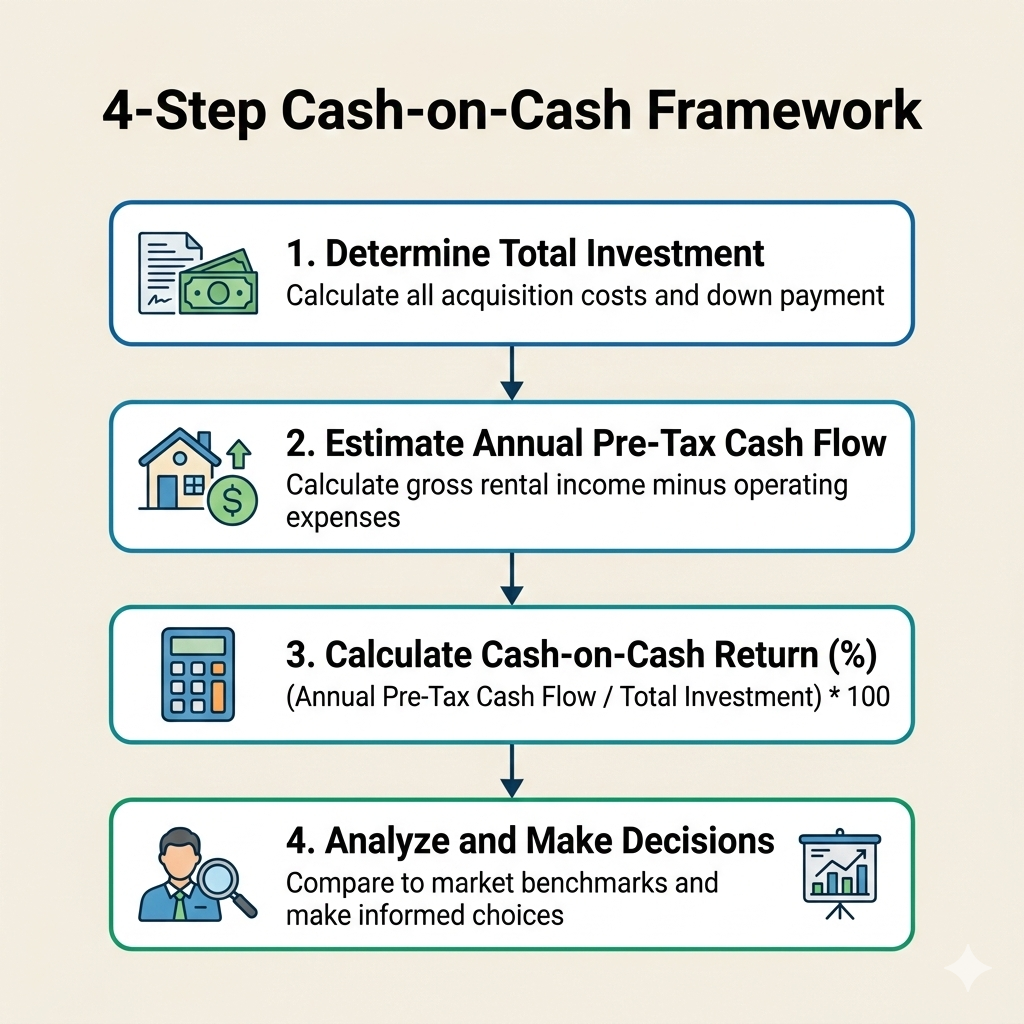
Cash-on-cash return connects a property’s annual pre-tax cash flow with the cash invested in it. The calculation is straightforward; deciding which numbers belong in it takes more care.
This four-step review covers cash flow, initial investment, and a downside scenario you can discuss with an investor.
What Cash-on-Cash Actually Measures (And Why It Matters)
At its core, cash-on-cash return answers one question:
How hard is my actual invested cash working for me this year?
Formula: Cash-on-Cash Return = Annual Pre-Tax Cash Flow ÷ Total Cash Invested
This example uses year-one performance. Keep the time period and assumptions visible when comparing properties.
The 4-Step Cash-on-Cash Framework
Work through the inputs in this order:
- Confirm true annual cash flow
- Confirm true cash invested
- Calculate baseline return
- Stress-test assumptions
Let’s break it down.
Step 1: Confirm True Annual Cash Flow
Do not rely on pro forma projections alone.
Checklist:
- Gross rental income
- Vacancy assumption (be realistic, not optimistic)
- Operating expenses (taxes, insurance, maintenance, management)
- Debt service
What you want: Net Operating Income (NOI) − Debt Service = Cash Flow Before Capital Spending, Reserve Funding, and Taxes
Hypothetical Example
Let’s say:
- NOI: $240,000
- Annual Debt Service: $180,000
Annual Cash Flow = $60,000
These inputs leave $60,000 before capital spending, reserve funding, and taxes. For the cash-on-cash illustration below, assume there are no additional cash outlays in year one. Actual cash available depends on the full property budget and financing terms.
Step 2: Confirm Total Cash Invested
Include all applicable upfront costs in the denominator.
Total cash invested includes:
- Down payment
- Closing costs
- CapEx reserves
- Initial improvements
- Fees (if paid upfront)
Example:
- Down payment: $400,000
- Closing costs: $25,000
- Initial improvements: $75,000
Total Cash Invested = $500,000
Check the closing estimate and improvement budget for costs missing from the worksheet.
Step 3: Calculate the Baseline Cash-on-Cash Return
Now the simple math: $60,000 ÷ $500,000 = 12% That’s a 12% cash-on-cash return.
That is the baseline for this example. Next, test how it changes when the assumptions change.
Step 4: Stress-Test the Return
Ask:
- What if vacancy increases by 5%?
- What if expenses rise 10%?
- What if refinance rates change?
- What if rent growth stalls?
Recalculate under a conservative scenario.
Show the revised inputs alongside the original case. The investor can then compare the projected return with their own requirements and discuss the downside.
How to Present This to Investors (Script Included)
Lead with the assumptions behind the number. This sample uses the hypothetical figures above:
“Using $60,000 in year-one pre-tax cash flow and $500,000 in total initial cash, the projected cash-on-cash return is 12%. That assumes no additional capital spending or reserve funding in year one. We should also review a downside case with the revised income and expense assumptions shown.”
Only describe a downside return after calculating it.
Common Mistakes to Avoid
1. Ignoring Capital Expenditures
A roof replacement in year two can materially change the cash available to the investor.
2. Overstating Rent Growth
Support rent-growth assumptions with relevant evidence.
3. Using Gross Instead of Net Numbers
Always work from NOI, not gross rent.
4. Presenting Only One Scenario
Serious investors want downside analysis.
When Cash-on-Cash Is NOT Enough
Cash-on-cash is powerful, but incomplete alone.
You still need:
- Cap rate analysis
- Debt coverage ratio (DSCR)
- Exit assumptions
- Market fundamentals
Use cash-on-cash alongside these measures, with the assumptions and limits of each calculation explained.
Download the free 10 CRE Terms Guide → https://khaitranofficial.com/cre-terms